Queensland Road Safety Week | 18–22 August 2025
Pedestrian safety: An urgent call for local government and state government to act
As Queensland Road Safety Week begins, I write with a heavy heart.
On the weekend, three devastating crashes involving four people occurred on our roads, so tragic that it underscores how urgently pedestrian safety must be addressed. One of those crashes was of a father and his four year old son who were fatally struck by the driver of a vehicle in Regents Park on Sunday, 17 August 2025, as they walked to grab ice cream according to media. Both the man and the 4 your old died at the scene. The two other crashes (yes, not accidents) were of an older woman on Friday 14th August who was using her mobility device and was hit by the driver of a Ford Ranger as she crossed Turton Street in Sunnybank. Police are appealing for information from the public. The third crash appears to be a man hit by a driver of a vehicle in Bundaberg, with the man suffering neck injuries.
We are not clear on all the details of Queensland crashes, as the details on injuries and deaths are always hard for us to find and review the circumstances of the crash and ways that we can prevent this from happening again. Of course, that’s part of our call for state government to act. Better data collection, better access to data, better engagement with representatives about the data, and listening to the experts’ recommendations.
Meanwhile, today’s data confirms that 178 people have already died on Queensland roads in 2025, with this tragedy of the father and son marking the ninth death within a week. These heartbreaks come atop a broader, alarming trend. Queensland has seen 178 road related deaths from January to 10 August 2025, a sobering increase that eclipses previous years and reignites concerns about public safety.

Image: Sustainable Transport Hierarchy featuring pedestrians as the highest order of priority
Why road safety matters for people walking
Pedestrians (walkers, runners, rollers and strollers) are the most valuable and yet the most vulnerable road users.
We’re valuable because as ‘walk ups’, we make the economy sing, our bodies shine and the environment hum. We’re vulnerable because we don’t come with seatbelts, airbags, or other protection. We can’t always see a vehicle coming, and we can’t always hear a vehicle coming. That makes us all vulnerable even if we have good sight and aren’t hearing impaired.
We’re all pedestrians, we all matter… and yet it has been a terrible year for road safety for pedestrians. A record even.
According to Street Smarts Queensland, on average 26 people walking lost their lives and 378 were seriously injured annually in Queensland. In recent national figures, pedestrian deaths in Queensland surged by 15.7 percent, contributing to a 5.9 percent statewide increase in road fatalities (303 deaths in the year to May 2025, compared to 286 the previous year). Queensland has one of the worst records of road safety – and it’s not getting better. RACQ have just released an incredibly useful tool which highlights the social cost of crashes in Queensland. Is investing more in Road Safety worth more than the social cost of $35.7 billion? We think so.
‘Experts warn the state is on track to match or exceed last year’s road toll of 302 deaths, which was the worst in more than a decade. “It’s time to get serious on road safety and crack down on dangerous drivers to save lives,” RACQ CEO David Carter said. “It’s clear we have a cultural crisis on our roads.” ‘ – ABC ‘New interactive map reveals Queensland’s deadliest crash hotspots‘
Image: Children wait with a crossing supervisor to cross at a primary school

Road Safety Week 2025: A timely opportunity
Queensland Road Safety Week is an annual awareness campaign running Monday 18 to Friday 22 August 2025. Queensland Road Safety Week is an opportunity for all of us to commit to safer roads, but to especially protect our most vulnerable on the roads through good infrastructure, higher investment and better driving. We encourage everyone, drivers, walkers and community groups, to get involved.
Drivers, asset owners, media, residents and decision makers must step up
Drivers. We beg you. It is not enough to talk about shared responsibility. All drivers and especially those drivers of SUVs and utes that are larger, heavier vehicles – you must take greater care and accountability for the risk you pose to our loved ones who are walking, who use mobility devices, and riding a bike.
Residents. We beg you. Cut out the pedestrian blame game. Call your local, state and federal members and remind them why safety when you walk is critical, it’s valuable.
Local councils, state and federal governments must urgently scale up investment in safer walking infrastructure. This means prioritising projects such as safer and protected crossings, wider and continuous footpaths, shaded routes, lighting upgrades and lower speed zones. Small pilot programs and piecemeal improvements are simply not enough. We also need much better reporting, with state and local government needing to step up to provide transparent data. There’s missing gaps in reporting and the information shared, and it makes it really hard for road safety advocates to do our jobs and to do it well.
Media, this is a desperate call to you: words matter. When the media reports a pedestrian death as an “accident,” it implies inevitability, as though nothing could have been done to prevent it. But these are not accidents, they are crashes, often the result of choices such as speeding, distraction, inattention or unsafe road design. Language shapes public perception and policy. Calling them crashes places responsibility where it belongs: with driver behaviour and with governments that fail to provide safe infrastructure. Until the media consistently reports these tragedies as preventable crashes, we risk normalising road deaths as an acceptable part of life in Queensland.
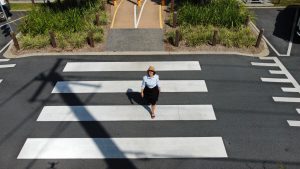
Image: Anna stands on a Raised crossing
What Queensland Walks is doing
Queensland Walks as part of this effort is amplifying awareness of critical risks:
- The Fatal Five: Speeding, distracted driving, driving under the influence, fatigue, and seatbelt non use, and how each disproportionately affects pedestrians.
- Hostile infrastructure where we walk must be improved to reduce trauma: We advocate for low speed zones (30 km/h around school and educational precincts and pedestrian areas such a high streets, 40 km/h on local streets), raised pedestrian crossings (“wombats”), removal or safer redesign of slip lanes with wombats, signalised crossings at all intersection points, and fully separated paths for e-mobility and walking.
Queensland Walks has long championed safer, more inclusive streets. Our recent initiatives include:

1. Safe streets

2. Safer crossings

3. Connected safe and hazard free paths
-
Hosting ‘Walkshops’ for daytime and nighttime safety in areas such as Spring Hill, Kingaroy, Southbank, Suncorp Stadium, Zillmere, Rockhampton, Lammermoor (and more coming) where residents and council staff walk local streets and provide input to prioritise pedestrian safety improvements such as reducing speeds, improving footpaths, installing safe crossings, and enhancing lighting thanks to funding from the Queensland Government (TMR and Queensland Health)
-
Participating in the Queensland State Government Parliamentary Inquiry into e mobility safety, and other road safety round tables and advisory groups with local and state government.
But these efforts cannot succeed without systemic change nor without funding. For decades, Queensland has invested heavily in roads and motor vehicle infrastructure whilst allocating tiny proportions of the transport budget to walking and cycling. In many years, less than 2 percent of total spending has gone towards active transport, despite the fact that every Queenslander walks. This underinvestment directly contributes to unsafe conditions on our streets.
This Road Safety Week, Queensland Walks calls on all drivers to slow down and take extra care around people walking, and we call on all levels of government to deliver the safe infrastructure our communities deserve. Death of our loved ones – of people who walk or run is preventable. These deaths are not accidents. They are the result of choices — both in how we drive and how we invest. It is time for Queensland to choose safety.
Anna Campbell
Executive Officer, Queensland Walks

Image: Board member Alison Durham,Queensland Walks; the hon State MP Dr Christian Rowan, Assistant Minister to the Premier on Matters of State and New Citizens; Anna Campbell, Queensland Walks.
References
Courier Mail. (2025, August 17). Two people fighting for life after car pedestrian crash in Logan. https://www.couriermail.com.au/news/emergency-services/two-people-fighting-for-life-after-car-pedestrian-crash-in-logan/news-story/6d10bc6194f5d73370e28dbb64a6f8c6
News.com.au. (2025, August 17). Fears for boy, man hit by car at Regents Park, Queensland. https://www.news.com.au/national/queensland/news/fears-for-boy-man-hit-by-car-at-regents-park-queensland/news-story/41e55e481c8cbf38f574511dc91949fe
Queensland Government. (2025). Pedestrians: road safety data and resources. https://streetsmarts.initiatives.qld.gov.au/pedestrians
Queensland Walks. (2025). Queensland Road Safety Week 2025. https://queenslandwalks.org.au/queensland-road-safety-week-2025/
University of Hawaii Economic Research Organization. (2024). Vehicle front-end height and pedestrian safety (UHERO Working Paper No. 2024-01). https://uhero.hawaii.edu/wp-content/uploads/2024/01/UHEROwp2401.pdf
World Energy Data. (2024, January 19). Australians are obsessed with SUVs and huge utes, but experts say they are making our roads deadlier. https://www.worldenergydata.org/australians-are-obsessed-with-suvs-and-huge-utes-but-experts-say-they-are-making-our-roads-deadlier/
The New Daily. (2025, May 14). SUV research confirms they are deadlier for pedestrians. https://www.thenewdaily.com.au/life/auto/2025/05/14/suv-research-deadly
The Conversation ( 2025, May 23) https://theconversation.com/australian-roads-are-getting-deadlier-pedestrians-and-males-are-among-those-at-greater-risk-256994